Qualitative Investigation of the AI Landscape with Extension and agInnovation Leaders
Following the dissemination of the quantitative survey, a qualitative focus group investigation was conducted during the first AI convening virtual meeting with Extension and agInnovation leaders and administrators. One hundred and six individuals representing 41 universities were in attendance.
The following themes emerged from the focus groups.
- Uneven Preparedness and Organic Adoption
Most institutions are in the nascent stages of AI assimilation. Efforts are frequently driven by individual faculty, team, or unit initiatives rather than being guided by a comprehensive institution-wide strategy. While a limited number of universities have begun formalizing their AI strategies, the majority are still in the exploratory phase, seeking entry points or conducting internal assessments to understand current AI usage. - Lack of Training and Organizational Infrastructure
A recurring concern among participants was the conspicuous absence of systematic training and guidance for AI tools. Current AI adoption predominantly relies on “self-taught” methods or informal peer-to-peer knowledge sharing, with few institutions offering structured professional development programs or dedicated support mechanisms. This observation aligns with findings from the quantitative survey, which indicated a reliance on peer networks and professional associations for AI literacy support among faculty and staff. - Fear, Resistance, and Misunderstanding
A segment of staff perceives AI as a potential threat, particularly concerning job security or the traditional face-to-face models. These apprehensions can manifest as resistance to or avoidance of AI technologies. - Fragmented Policy and Ethical Concerns
Institutions largely lack clear, overarching policies or definitive guidance regarding the appropriate and responsible use of AI. Specific areas of concern include compliance with regulations such as FERPA, intellectual property rights, questions of AI authorship, and broader ethical boundaries for AI applications. - System-wide Constraints: Capacity, Resources, and Knowledge Silo
Intrinsic challenges significantly impede progress in AI assimilation. These include budgetary constraints, a shortage of staff proficient in AI, and the adverse effects of siloed knowledge, which collectively hinder cohesive advancement. - Strong Interest in Shared Resources and Communities of Practice
There was a broad consensus among participants regarding the critical need for shared resources. This includes standardized training and onboarding materials, clear policy templates, easy-to-access case studies illustrating responsible and effective AI utilization, and the establishment of cross-state learning communities or collaborative working groups to foster shared learning and best practices.
Summary of Qualitative Findings
- The qualitative investigation with Extension and agInnovation leaders reveals a complex, yet promising, landscape for AI assimilation. While a prevailing enthusiasm for AI exists, its practical adoption across the system is largely decentralized and organic, driven more by individual or unit-level initiative than by top-down strategic planning. This grassroots interest is a testament to the adaptability of Extension and agInnovation professionals, despite some significant intrinsic vulnerabilities.
- A critical finding is the pervasive lack of formal training and robust organizational infrastructure to support AI adoption. This void forces reliance on self-taught methods and peer sharing, which, while indicative of strong internal networks, cannot substitute for structured professional development and clear guidance from institutions. Furthermore, the presence of fear, resistance, and misunderstanding surrounding AI, particularly concerning job security, underscores an urgent need for transparent communication and educational initiatives to demystify AI’s role in augmenting, rather than replacing, human expertise.
- Compounding these challenges are fragmented policies, significant ethical concerns (e.g., data privacy, algorithmic partiality), and system-wide impediments such as budget constraints, limited AI-literate staff, and knowledge silos. These factors collectively hinder a cohesive and ethically sound approach to AI.
- Despite these hurdles, the consistent demand for shared resources and vibrant communities of practice presents a substantial opportunity. The strong desire for standardized training, policy templates, case studies, and collaborative learning environments indicates a readiness among leaders to engage in collective action.
Implications and Opportunities for Extension and agInnovation
- Strategic Alignment Imperative:
The decentralized nature of AI adoption highlights the critical need for a centralized, system-wide AI strategy. This strategy has the potential to leverage existing organic efforts while providing overarching guidance, resources, and policy frameworks to ensure consistent, ethical, and practical adoption. - Prioritization of AI Literacy and Training:
Addressing the deficiency in training is paramount. Developing and delivering systematic professional development programs—potentially leveraging existing peer networks—would be crucial for building AI literacy, mitigating fear, and empowering faculty and staff. - Proactive Policy Development:
There is an immediate need to develop clear, comprehensive policies addressing AI use, ethical considerations, data privacy, and intellectual property. These policies must be communicated effectively across all units to foster responsible innovation.
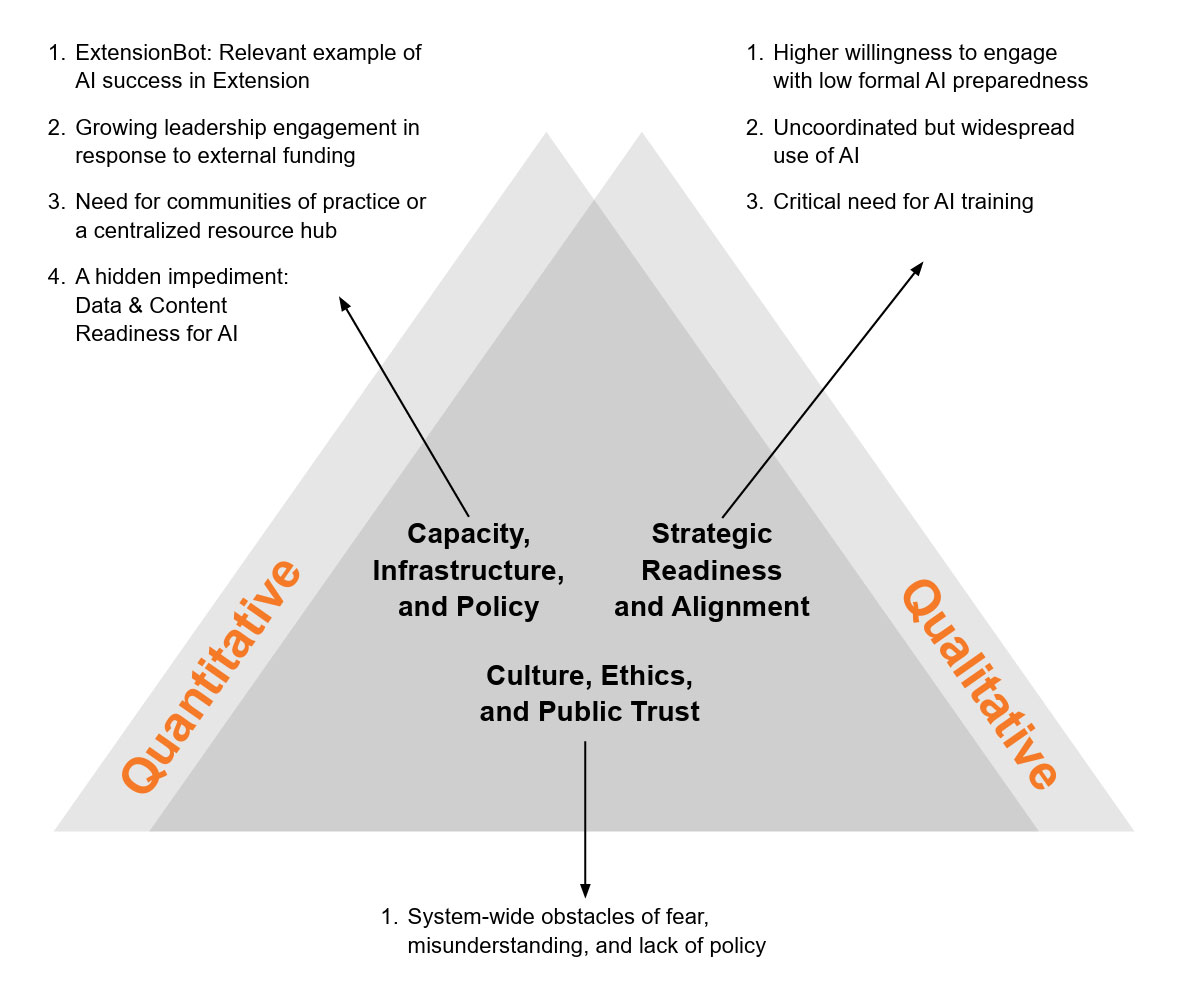
Triangulation of Quantitative and Qualitative Findings
on Current AI investigation in Extension and agInnovation.