National Extension Technology Community (NETC) AI Track

About the Extension Foundation’s AI Initiative

Founded in 2006 by Extension leaders, the Extension Foundation has been instrumental in advancing technology adoption in Cooperative Extension. 

The Foundation partners with Cooperative Extension through liaison roles and a formal plan of work with the Extension Committee on Organization and Policy (ECOP) to increase system capacity while providing programmatic services and helping Extension programs scale and investigate new methods and models for implementing programs. The Extension Foundation also provides leadership for technology adoption, focusing on Artificial Intelligence (AI) and administering commercial systems for Cooperative Extension to use nationally.

AI image

Our AI initiatives are supported by a New Technologies in Ag Grant (NTAE) from the United States Department of Agriculture, National Institute of Food and Agriculture (USDA NIFA) funding opportunity USDA-NIFA-OP-010186 (award number 2023-41595-41325), in partnership with the University of New Hampshire. Previous work was supported by NTAE grant no. 2020-41595-30123 from USDA NIFA via a partnership with Oklahoma State University. Any opinions, findings, conclusions, or recommendations expressed in this publication are those of the author(s) and do not necessarily reflect the view of the U.S. Department of Agriculture.

Funding from this grant enabled the Foundation to offer an AI-related track at the 2024 National Extension Technology Conference (NETC), an annual gathering for Extension technology professionals that offers important networking and professional development opportunities. The conference is organized by the National Extension Technology Community, a nonprofit organization dedicated to extending professional development, education, and networking opportunities to Cooperative Extension employees. Learn more.

This year’s conference in State College, Pennsylvania, brought together experts to share insights and innovations shaping the future of Extension, with a special track of more than a dozen sessions dedicated to AI.

The Potential of AI

Artificial intelligence (AI) can help Cooperative Extension professionals by:

  • Enhancing efficiency and reach:
    AI can help Extension professionals automate routine tasks such as agenda creation and taking notes in meetings. This can free up time to focus on other tasks. AI can also help in outreach efforts by creating social media posts, personalized communication, and providing language translation.
  • Improving data analysis:
    AI can be valuable in evaluating and assessing data, helping to identify trends, predict outcomes, and make informed decisions. This data analysis can inform program development and resource allocation.
  • Delivering personalized services:
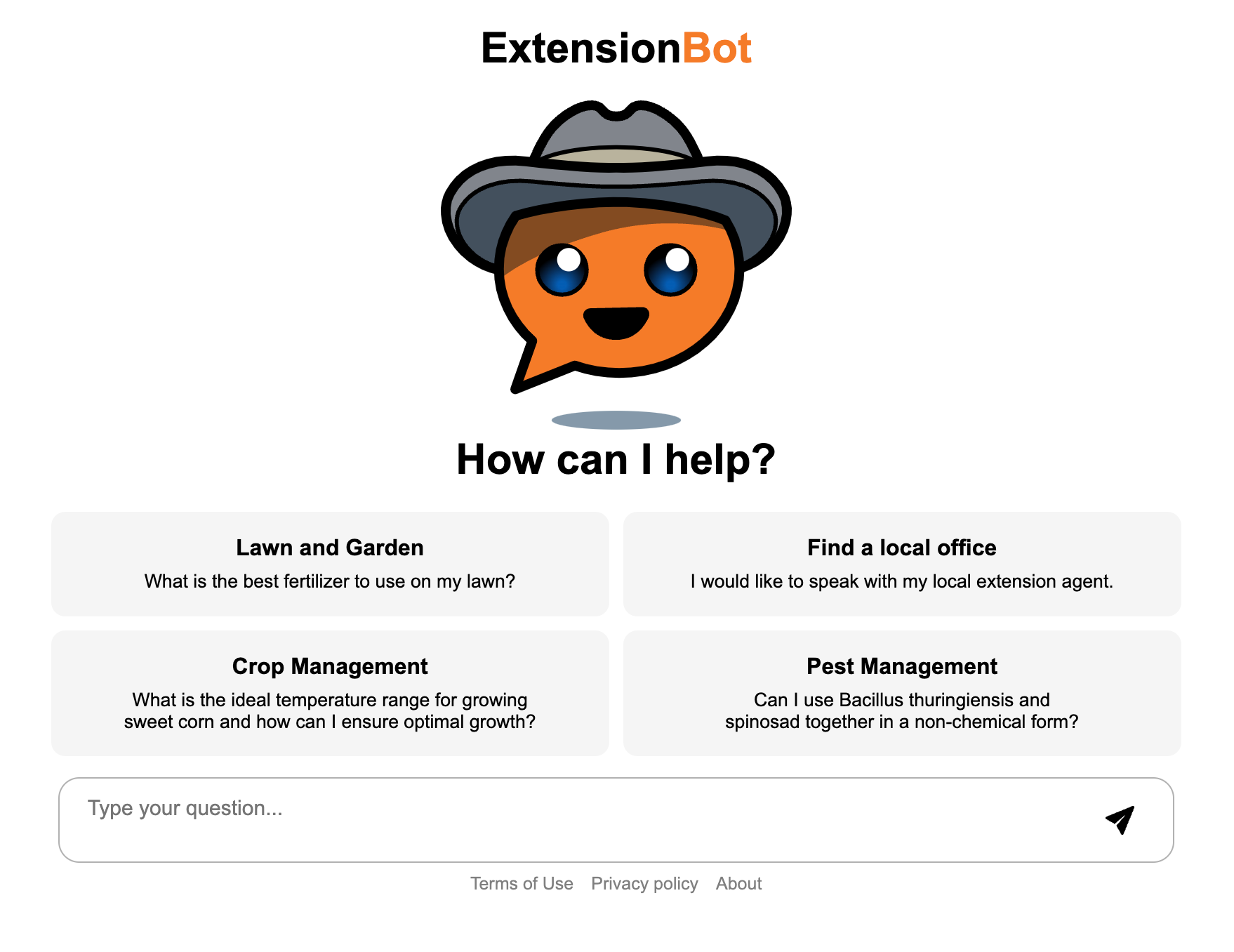
    AI-powered tools can be used to provide tailored recommendations and information to clientele based on their specific needs and queries. ExtensionBot is one example of this.
  • Expanding the knowledge base:
    AI can be valuable in curating and organizing information from a wide range of sources.

The Foundation’s Technology Solutions team is actively engaged in advancing the adoption of AI in Extension. How can we support your efforts?

National Extension Technology Conference AI Track

As part of NETC’s annual technology conference the Extension Foundation partnered with NETC to sponsor and organize an Artificial Intelligence track for the conference. This AI track was organized by Mark Locklear (Extension Foundation) and David Warren (Extension Foundation and Oklahoma State University).

Workshops and presentations included tools and services available to CES (Extension Bot and Ask Extension), data gathering from Land-grant universities (crawling of Extension websites, data pipeline and maintenance), education and training (best practices of AI use in CES), and data governance (inclusion of CES stakeholders, convening an AI advisory board, user feedback and input).

The program schedule is available here. Note that on the NETC agenda the AI track sessions are listed as “Pink.”

AI Keynote: Redefining Connection: Next-Generation AI and the Rediscovery of Community

Elliott Robson, CEO, Eduworks

This keynote discusses human-machine interaction, machine-human interaction and how the next step in AI is an opportunity to rediscover the local in our shared digital world. Technically, the keynote covers the movement from large foundation models to AI-powered applications that enhance everyday life. As part of this keynote, Mr. Robson will demonstrate new research and next-generation AI architectures including AI microservices. This presentation is intended to address the important human-related elements of generative AI, including the reemergence of the third place as well as the technology that underlies them.

View the presentation here.

AI Session Abstracts and Presentations

The following list outlines the presentations that were featured at the conference. Each listing includes the presenter’s contact information, a brief summary of the presentation’s content, and a link to the presentation materials, if available.

Diana Morian
Dr. Karen DiCicco
University of Arkansas Extension

Contact: dmorian@uada.edu

The Cooperative Extension Service plays a crucial role in delivering research-based knowledge and resources to communities across various domains, including agriculture, health, nutrition, and economic development. With the increasing integration of artificial intelligence (AI) technologies in Extension programs and services, there is a pressing need to establish guidance and policy frameworks to ensure responsible and ethical AI adoption. To meet this demand, we’re offering a specialized AI Guidance and Policy Workshop for Cooperative Extension professionals. This dynamic workshop encourages active participation, so don’t forget to bring your laptops, sample guidelines/policies, and innovative ideas. Moreover, it aims to cultivate a collaborative network that extends beyond the confines of the conference.

View the presentation here.

AI Guidelines and Procedures template.

Dr. Nazia Arbab, Assistant Professor & Agribusiness/Resource Economist Specialist 
University of Maryland Eastern Shore Extension

Contact: nnarbab@umes.edu

Computer vision (CV) and natural language processing (NLP), have made significant advancements due to the existing AI technologies. These AI-driven technologies are time and cost-efficient at specific, well-defined tasks. However, these technologies do not incorporate the context and meaning, which are extremely important in applying these AI methods to uncertainty and risk measurements needed for climate-smart agriculture to build agricultural resiliency. The goal of this project is to build directions to address these challenges by leveraging climate-resilient foundational AI methods in synergic expertise in climate, hydrology, geography, and agriculture.The augmented SEDS tool will enable farmers to make socioeconomic decisions at short and long-term time scales on production practices, crop selection, and production inputs. AI technology will leverage SEDS by linking data on emerging issues from crop diseases to fluctuations in weather events. AI-driven predictive models can enable farmers to make socioeconomic decisions at short and long-term time scales on production practices, crop selection, and production inputs.

View the presentation. 

Mark Locklear
Extension Foundation

Join us for an engaging hands-on workshop where Mark Locklear will introduce the CRAFT framework for effective AI Prompting. Get ready to dive into interactive AI prompting exercises, where participants will have the opportunity to apply the principles of the CRAFT framework firsthand. Gain valuable insight into the fundamentals of AI prompting, explore the core components of the CRAFT framework, and discover practical applications tailored to the Cooperative Extension Service. By the workshop’s conclusion, attendees will not only have acquired practical skills in implementing AI prompting techniques but also gleaned insights from shared experiences, leaving them feeling empowered to seamlessly integrate AI prompting into their daily work, ultimately enhancing efficiency and effectiveness. Don’t miss out on this transformative workshop experience!

View the presentation.

Naimani Staley
Maria Barga
University of Maryland Extension

Contact: nstaley@umd.edu

Tired of being buried in administrative tasks while frantically trying to figure out how to get through the 3 pages of unanswered emails waiting for you in your inbox? Perhaps you’re not sure of how to respond to that one email? According to a study by ReclaimAI, the average worker spends almost 2 hours per day on unproductive tasks. Join Tech Educators, Maria Barga and Namani Staley, from the University of Maryland Extension to discuss and explore different ways AI can be used to streamline trivial tasks, optimize time, and break down the physical barriers of working from a distance allowing for more collaboration amongst programs and connecting team members within Extension.

View the presentation.

Dorothy Nuckols
Dr. Jesse Ketterman
Catherine Sorenson
University of Maryland Extension

Contact: dnuckols@umd.edu

Leadership within Extension is multidimensional. Leadership skills are essential for supervising, mentoring, collaborating, teaching, researching, advising, partnership-building, administering, and more. Most of us engage within multiple spheres, 24/7/365. Communication is the top skill needed for effective leadership. However, one of the most challenging forms of communication is behavior change, whether change is needed for adapting to new programs, processes or environments, or for altering attitudes, behaviors, or performance. To be successful, leaders need to know researched, theory-based, behavior-focused interpersonal communication strategies for fostering behavior change. Instead of the old approaches of “I know what you need” and “educate & instruct,” the leader communicates, “you have what you need within yourself, I’ll help you explore that.” Motivational interviewing (MI) is an underutilized but complex communication technique. MI requires specific conversation skills on the part of the leader/mentor to help the subordinate/mentee overcome personal hurdles and change resistance. Artificial Intelligence (A) is an emerging technology which can help build leader/mentor communication skills. AI can assist mentoring conversations with well-crafted and targeted question and response prompts to facilitate the kind of behavior change that will support the productivity goals of the Extension program and the personal goals of the employee. MI depends on the use of open questions, affirmations, reflective listening, and summary language to evoke a mentee’s motivation for change. AI can be instrumental in guiding the mentor to have the “right words at the right time” during these complex conversations. The session highlights an example of incorporating AI into Extension consumer and volunteer training programs. During the session, three progressive and interactive activities will be used to engage participants and practice skills. The first will be an exercise to identify individuals’ readiness for change, the second will be a guided, small group motivational interviewing practice, and the final will be an interactive exploration of using an AI platform to assist with motivational interviewing skills.

View the presentation.

Julika von Stackelberg
Cornell Cooperative Extension

Contact: jv426@cornell.edu

Technology is arguably the most influential phenomenon that continues to shape our world drastically. From the first printing presses that allowed for the dissemination of narratives that formed nations to individuals like Richard Branson starting a rocket company and sending himself into space, technology plays a vital role in the world we live in.In this session, participants will gain an overview of the impact of the data that inform large language models and machine learning processes of artificial intelligence (AI). Participants will also learn about the risks of reproducing past and current inequities due to biased data and learn to apply a critical lens when working with AI-based tools to ensure the well-being of all.

View the presentation.

David Warren
Extension Foundation/Oklahoma State University

Contact: davidwarren@extension.org 

The ExtensionBot project is a groundbreaking initiative that harnesses the power of artificial intelligence to deliver trustworthy, research-based answers to the public, drawing upon the vast knowledge and expertise of the Cooperative Extension Service. By training large language models exclusively on data provided by Extension institutions, ExtensionBot ensures that its responses are grounded in reliable, verifiable information. This presentation will provide an overview of the project’s goals, the technology behind ExtensionBot, and the collaborative efforts of contributing institutions. Attendees will learn how ExtensionBot aims to enhance the accessibility and reach of Extension resources while maintaining the highest standards of accuracy and credibility.

View the presentation.

Mark Locklear
Extension Foundation

Contact: marklocklear@extension.org

As the  Cooperative Extension service increasingly integrates AI technologies into its operations, it is imperative to critically examine the ethical implications of these advancements. In this talk, we will explore the ethical considerations specific to the Extension context, focusing on how AI can be deployed responsibly to uphold the values of integrity, equity, and  transparency in Extension programming and outreach efforts. Through real-world examples and case studies, we will discuss the ethical challenges and dilemmas Extension professionals may encounter when implementing AI technologies, and strategies for mitigating bias, ensuring fairness, and promoting ethical decision-making. 

View the presentation.

Joe Gasper
University of Florida

Contact: gasperj@ufl.edu

Fasten your seatbelts for a fast flight into the AI-driven world with Microsoft Copilot. This session is your boarding pass to explore how Copilot enhances productivity in higher education and extension services. Microsoft’s Copilot services are your personal assistants that never need vacations (but can help you plan one!) Understand the robust Commercial Data Protection policies safeguarding your information with Microsoft Copilot. Start crafting effective prompts to unlock the potential of Copilot’s capabilities. Through live demonstrations, see how Copilot integrates with M365 apps to streamline document creation, meeting summaries, barnstorming, data analysis, and more. Embark on this journey to join the Copilot #FlightCrew.

Presentation pending. Will be posted when available.

Abdelaziz Lawani
Jason P. de Koff
University of Tennessee

Contact: alawani@tnstate.edu

Generative Artificial Intelligence (GenAI) has experienced remarkable growth in recent years, finding diverse applications across various fields, including linguistics, information technology, banking, education, art creation, music composition, and more (Dwivedi et al., 2023). In extension, the potential of generative AI extends to the delivery of tailored and personalized extension services. For instance, it can augment extension agents’ capability to generate responses to the numerous questions they encounter daily and automate routine tasks associated with extension services. Despite the promising potential of generative AI for enhancing extension services, to the best of our knowledge, there is no documented use case for its implementation in this context. This gap can be attributed, in part, to a lack of awareness among extension agents. Even when they become aware of this technology, they may encounter challenges related to the necessary technical expertise required for effective utilization. Using the case of Tennessee Cooperative Extension Services (TCES), the present study seeks to investigate the extent of knowledge and utilization of generative AI among extension agents and identify the potential for innovation and optimization in their practices using this technology. Finally, it uses ChatGPT to illustrate how GenAI is used in Extension through a case study.

Presentation pending. Will be posted when available.

Archana Karanam
Digital Green

Contact: archana@digitalgreen.org

In the face of pressing challenges like gender inequity and climate change, small-scale farmers worldwide require innovative solutions to enhance their productivity and livelihoods. Digital Green works with nearly 100,000 government extension agents and 6 million smallholder farmers, 60% of whom are women, who have produced over 8,000 videos by and for farmers in 50 languages. These videos have significantly enhanced the efficiency of public extension systems, reducing the cost-per-adoption of improved practices from $35 to $3.50 and increasing farmer incomes up to 24%.  Building on this success, Digital Green and the Ministry of Agriculture in India launched an AI-powered open agricultural content network, called VISTAAR, to further lower costs to below $0.35 per farmer, emphasizing climate-smart and gender-inclusive practices. VISTAAR is built using AI and a content network. Through an AI-enabled chatbot, extension agents use voice and text notes to submit queries in local Indic languages, an important feature for low literacy populations. Query responses include links to source citations, including relevant local language videos. The system also orchestrates integrations with dynamic data sets like real-time location and season-specific weather forecasts. A combination of both human-led feedback, expert review, and automated evaluation is used to improve bot performance. Additionally, Digital Green is integrating with other modes of communication, such as interactive voice response (IVR) and text messaging systems, that do not require smartphones. VISTAAR is built to be flexible digital public infrastructure (DPI) and can integrate with both open and proprietary Large Lange Models (LLMs) and automated speech recognition (ASR) models to optimize quality, cost, and governance factors across a variety of contexts. Using a retrieval augmented generation (RAG) pipeline trained on advisory videos, call center logs, and factsheets, content sources are vetted and maintain accountability. Techniques like reranking and filtering have been found to significantly decrease hallucinations from 23% to 0% and reduce responses with irrelevant information from 37% to 3% of the customized advisories. Nearly 4,000 extension agents serving more than 350,000 farmers use this system in India today with integrations with popular messaging platforms, like Telegram.  Female extension agents have been found to use this system more than twice as much as their male counterparts.  VISTAAR creates an innovative, scalable network that anyone in the agricultural sector can tap into to share content, support extension, and build their own custom bots, all with a codified governance structure.  This initiative is not only gaining momentum in India but other countries eager to adapt this digital public infrastructure to their own agricultural contexts, including Kenya, Ethiopia, Nigeria, and the US.

View the presentation.

Kris Baldwin, Ed.D
Kristi Elmore
Iowa State University Extension and Outreach

Contact: kbaldwin@iastate.eu

In this presentation, we delve into the transformative power of AI, exploring how it enhances efficiency, fosters innovation, and opens new avenues for growth. Through real-world examples, we demonstrate how industry peers successfully integrate AI into their daily workflows. Additionally, we share insights from our own experience in developing guidance around the utilization of generative AI within Cooperative Extension. (proposal description generated by Microsoft Copilot).

View the presentation.

Takeaways and Next Steps

Takeaways
All those attending the conference (approximately 400) had the opportunity to hear Elliot Robson, CEO of Eduworks Corporation, offer a keynote about AI. 

The AI track proved popular, with 357 participants across the sessions.

A survey was conducted and 42 responses were received.
After participating in the AI sessions, 71% of respondents indicated they were more comfortable incorporating AI into their work.

Next Steps
The Extension Foundation is continuing to build out ExtensionBot and Merlin, which is the data gathering platform. ExtensionBot has moved out of beta testing to full production with the latest release in mid-September 2024. The Extension Foundation is using a so-called “frontier model” in Llama 3.1, and is also introducing an expansion layer that includes multiple specialized models.

Staff members Mark Lockler and David Warren will continue to offer presentations and accept speaking engagements to promote AI, with a focus on ExtensionBot and Merlin.

NETC Thank you sign

Other AI Information, Presentations and Resources from the Extension Foundation

The Extension Foundation supports the professional success of Extension leadership and professionals seeking to use AI through tailored professional development, including speaking engagements, training, webinars, in person meetings, and networking opportunities.

Get Involved: AI Advisory Board
The Extension Foundation is convening an AI Advisory Board. This board will consist of Extension Foundation staff and representatives from participating institutions. The Advisory Board will help guide policy, feature development, and implementation of AI tools such as ExtenstonBot. Additionally, this group can help guide the future of AI within the broader Cooperative Extension Service. For more information, please email Mark Locklear at the Extension Foundation.

ExtensionBot

Recent Presentations
Mark Locklear and David Warren lead the Extension Foundation’s AI efforts. They frequently speak about AI at conferences. Below are some of their recent presentations. 

Mark Locklear

Mark Locklear, MS Technology Solutions
Extension Foundation/North Carolina State University

David Warren

David Warren, MBA Artificial Intelligence Program Leader
Extension Foundation/Oklahoma State University

AI and Extension

Presentation for the National Extension Directors Association Meeting (9/2024)

David Warren, Extension Foundation and Oklahoma State University

Review the PowerPoint presentation.

AI in Production Q&A

with Mark Locklear, Extension Foundation (2024)

Read Interview

ExtensionBot: A Domain Specific Gen AI Tool for the Cooperative Extension Service

AI in Production presentation
Mark Locklear, Extension Foundation

(runtime 35 minutes)

Use of AI at the Extension Foundation

Program Center Stage presentation
Mark Locklear, Extension Foundation

(runtime 57 minutes)

CES Update + Artificial Intelligence presentation

Dr. Damona Doye, ECOP Chair, Oklahoma State University
David Warren, Extension Foundation and Oklahoma State University

(runtime 60 minutes)

Resources

Ethics in AI

Ethics in AI, Created by Mark Locklear

AI Prompting, Created by Mark Locklear