2026 National AI Report


Authors
Aaron Weibe, Ph.D.
Director of Technology Services & Communications
Extension Foundation
aaronweibe@extension.org
Dhruti Patel, Ed.D.
Senior Agent, Family & Consumer Sciences
University of Maryland Extension
dhrutip@umd.edu
David Warren
Senior Director of Integrated Digital Strategies
Oklahoma State University & Extension Foundation
davidwarren@extension.org
Mark Locklear
Digital Systems & IT Operations Manager
Extension Foundation
marklocklear@extension.org
Acknowledgments and Appreciation
The Extension Foundation extends its sincere gratitude to the leaders, partners, and facilitators whose dedication made this work possible.
Dr. Damona Doye
Associate Vice President, Oklahoma Cooperative Extension Service, Oklahoma State University
Dr. Alton Thompson
Executive Director, Association of 1890 Research and Extension Administrators (AERA), based at North Carolina A&T State University
Dr. Beverly Coberly
Chief Executive Officer, Extension Foundation
Bill Hoffman and the Extension Committee on Organization and Policy (ECOP)
David Warren
Oklahoma State University & Extension Foundation
Dr. Aaron Weibe
Extension Foundation
Dr. Dhruti Patel
University of Maryland Extension
Mark Locklear
Extension Foundation
Ashley Griffin
Chief Operating Officer, Extension Foundation and the New Technologies for Ag Extension (NTAE) program
University of New Hampshire Extension
Extension Foundation Staff and AI Advisory Board Members
For serving as facilitators and moderators during the focus group sessions, ensuring productive and forward-focused dialogue throughout Parts II and III of the Convening.
agInnovation and Extension Directors and Administrators
For their time, thoughtful engagement, and contributions to shaping the national conversation on AI readiness, strategy, andimplementation across the Land-grant system.
Regional Extension and agInnovation Directors and Administrators
USDA National Institute of Food and Agriculture
Joint Council of Extension Professionals

This report is supported in part by New Technologies for Ag Extension (funding opportunity no. USDA-NIFA-OP-010186), grant no. 2023-41595-41325 from the USDA National Institute of Food and Agriculture. Any opinions, findings, conclusions, or recommendations expressed in this publication are those of the author(s) and do not necessarily reflect the view of the U.S. Department of Agriculture.
This report discussed the current AI Landscape across Cooperative Extension and agInnovation in the Land-grant university system. Through a sequential systems mixed-methods study, it comprehensively investigated the views of leaders in Cooperative Extension and agInnovation, followed by ground-level realities of Extension professionals engaged in community efforts. The initial study report published in late 2025 focused on Directors and Administrators in Cooperative Extension and agInnovation, capturing system-level perspectives on governance, infrastructure, workforce development, and strategic priorities for AI adoption.
In February 2026, the study was expanded to include direct engagement with Extension professionals across roles and program areas during the Joint Council of Extension Professionals (JCEP) national conference in Savannah, Georgia. This additional phase introduced critical workforce-level insights, capturing how AI adoption is being experienced in practice by agents, specialists, and educators working on the ground.
The inclusion of these perspectives revealed important areas of alignment and key gaps between leadership strategy and operational reality. While leaders emphasized coordination, infrastructure, and long-term opportunity, Extension professionals highlighted immediate challenges related to capacity, policy clarity, ethical considerations, and day-to-day implementation.
As a result, this report has been updated to reflect both 2025 leadership findings and 2026 workforce insights. Together, these combined perspectives provide a more complete and system-wide understanding of AI readiness across the Land-grant system.
Artificial intelligence (AI) represents a defining technological shift that is rapidly influencing how Land-grant Universities fulfill their public missions of research, education, and community service. Across both Cooperative Extension and agInnovation (Research) systems, AI holds the potential to enhance how science is generated, translated, and applied, improving accuracy, efficiency, and availability, while also introducing new responsibilities related to governance, workforce transformation, data safety, transparency, and ethical use.
Recognizing this pivotal moment, the Extension Foundation (EXF), in collaboration with the University of New Hampshire Extension and supported through the New Technologies for Ag Extension (NTAE) cooperative agreement with USDA’s National Institute for Food and Agriculture (NIFA), led a national effort to understand the evolving landscape of AI within both Extension and Research components of the Land-grant system. Contributing members included the Extension Foundation, Oklahoma State University Extension, and University of Maryland Extension.
This effort built upon current EXF initiatives that had already begun exploring practical AI applications for the system, including tools such as ExtensionBot and the MERLIN data management platform, both of which demonstrate early-stage models of AI-enabled information discovery and decision support.
The purpose of this study was to move beyond early exploration and toward a coordinated, system-wide framework for AI integration across Extension and agInnovation networks. Through a combination of survey research and facilitated convenings, and expanded field-based engagement, the study examined institutional readiness, workforce development needs, policy structures, and both leadership and practitioner perspectives on responsible AI use across both missions.
Leaders across the Land-grant system identified three overarching priorities that define how Extension and Research should guide AI adoption nationally:
These priorities establish the foundation for the next phase of AI leadership across the Land-grant system. However, findings from the expanded study indicate that successful implementation will require not only a coordinated leadership strategy but also AI guidance/policy, direct alignment with the day-to-day realities, capacity- building efforts,, and ethical considerations experienced by Extension professionals on the ground.
To explore these priorities in depth, the study was originally organized in four sequential phases. It began with a national AI Landscape Assessment to establish a baseline understanding of readiness and current use across institutions. This was followed by three AI Convenings, one virtual and two in person, that engaged both Extension and agInnovation Directors and Administrators in identifying priorities, validating findings, and developing actionable implementation strategies.
In early 2026, the study expanded to include a fifth phase, incorporating direct engagement with Extension professionals across program areas and roles through in-person data collection at the JCEP national conference. This additional phase provided a critical comparative lens, enablingallowing for analysis between leadership-level strategy and on-the-ground experience.
The following sections outline the timeline of activities, the methods used, and the findings that emerged through this coordinated process.
The study took place over a concentrated four-month period from June through September 2025. Each phase was designed to build upon the previous one, progressing from environmental scan to structured dialogue to consensus on leadership priorities and implementation strategies.The process intentionally combined the perspectives of both Extension and agInnovation leadership to ensure alignment across Extension and agInnovation.
This timeline reflects a deliberate design. The initial landscape assessment provided a system-wide view of readiness, the virtual convening established shared current perspectives, and the two in-person convenings allowed leaders to establish priorities and co-create strategies for ethical governance, workforce training, and long-term infrastructure development. The sequence positioned the Land-grant system to move from awareness to coordinated priorities and future plans around AI adoption.
In early 2026, the study was expanded through an additional phase of engagement with Extension professionals at the Joint Council of Extension Professionals (JCEP) national conference. This phase extended the original timeline by incorporating workforce-level perspectives, enabling a more comprehensive understanding of AI adoption across roles, program areas, and institutional contexts.
The expanded phase provided a critical complement to the original design, allowing for comparison between leadership-driven strategy and the lived experience of Extension professionals, and strengthening the overall validity and applicability of the study’s findings.
This study used a four-phase, sequential systems/mixed-method research methodology to capture the current state of AI perspectives, priorities, and implementation strategies of Cooperative Extension and agInnovation (Research) leaders within the Land-grant system. In early 2026, the study was expanded to include a fifth phase to incorporate perspectives from Extension professionals across the broader workforce, allowing for a more comprehensive, system-wide understanding of AI adoption.
The process intentionally engaged Directors and Administrators across 1862, 1890, and 1994 institutions, representing the full research and outreach missions of the system. The expanded phase additionally engaged Extension professionals across roles, including agents, educators, and specialists, broadening the dataset beyond leadership perspectives. However, the 1994 representatives were not present for discussion during the original in-person conversations and are only reflected in Phase 1 and Phase 2.
Phase 1
The study began with a national AI Landscape Assessment (June–July 2025) designed to measure institutional readiness, current use cases, governance and policy, and leadership perspectives regarding AI adoption. The structured survey was distributed across all 112 Land-grant Universities, capturing responses from Extension and Research professionals. 47 respondents from 29 different states participated in this initial survey. Quantitative results established a baseline of widespread enthusiasm for AI alongside notable gaps in policy, training, and coordination.
Phase 2
The second phase took place in July 2025 as a series of simultaneous, regional breakout sessions:11 small, structured focus groups facilitated by members of the Extension Foundation staff and the national AI Advisory Board. More than 100 participants representing 41 universities took part in these 90-minute discussions. Following a brief overview of survey results, each group was guided under a single framing question, “Where are we now with AI?” which was explored through related sub-questions addressing current awareness and ongoing initiatives; perceived challenges and risks; and emerging opportunities for Extension and Research. These regional focus groups provided the first qualitative layer of data, illustrating both the promise and fragmentation of AI activity across the Landgrant system. Phase 1 and Phase 2 data were triangulated to draw themes for the prioritization activity.
Phase 3
Phase 3, held in September 2025, focused on collective prioritization through two sequential 45-minute activities.
Activity 1, Brainstorming: The purpose of this phase was two-fold:
Participants were provided with a synthesis of findings from Phase 2 and asked to generate as many ideas in small groups as possible for how Cooperative Extension and agInnovation could advance AI policy, strategy, and application. Prompts focused on three key areas derived from the initial report:
Activity 2, Prioritization: Immediately following the brainstorming session, participants reviewed the full set of submitted ideas and deliberated to identify their top three priorities within each category. Using a structured worksheet and shared online database, groups collectively determined the nine most significant priorities to guide future implementation.
Phase 4
Between Phases 3 and 4, the facilitation and analysis team used ChatGPT and Google Gemini tools to assist in synthesizing the data collected from brainstorming and prioritization sessions. These tools helped consolidate hundreds of qualitative responses into thematic clusters by identifying redundancy, similarity, and co-occurring concepts across the datasets. The AI-assisted synthesis was then reviewed manually to ensure validity, accuracy, and interpretive rigor.
Participants then self-selected into breakout groups according to their area of greatest interest. Each group was tasked with developing strategies that could move these priorities from concept to practice, focusing on both immediate and long-term actions.
Facilitators guided each group through two key prompts: What strategies and resources are needed to implement these priorities? What barriers exist, and how can they be overcome?
To ensure applied outcomes, participants were encouraged to consider institutional structures, funding opportunities, partnerships, and mechanisms for accountability. Discussions were documented through shared digital forms, with each group’s scribe capturing proposed actions, obstacles, and enabling conditions.
The emerging themes represent the integrated leadership vision for AI within the Land-grant system, connecting ethical alignment, human oversight, workforce development, and shared infrastructure as mutually reinforcing priorities for future action.
During Phase 4, participants reconvened in person to review the top nine priorities including three under each of the key focus areas, and to develop strategies for action. In partially facilitated breakout discussions, participants explored the specific resources and partnerships needed for implementation, barriers that might impede success; and strategies to overcome those barriers and operationalize their ideas within institutional and system-wide contexts.
Phase 5
The fifth phase of the study was conducted in February 2026 during the Joint Council of Extension Professionals (JCEP) national conference in Savannah, Georgia. This phase expanded the research beyond leadership perspectives by directly engaging Extension professionals from across program areas and career stages.
Participants contributed through structured activities designed to capture both individual and collective perspectives on AI adoption in their daily work. These activities generated qualitative data reflecting real-world application, perceived risks, ethical concerns, and operational constraints associated with AI integration.
The purpose of this phase was to validate, challenge, and extend the findings from earlier phases by introducing a workforce-level lens. While Phases 1–4 focused primarily on institutional readiness, leadership priorities, and strategic direction, Phase 5 captured the lived experience of implementation, including the practical realities of workload, training capacity, trust, and mission alignment.
Data collected during this phase were synthesized alongside prior findings to identify areas of convergence and divergence between leadership-level strategy and on-the-ground experience. A comparative analysis enabled the identification of systemic tensions, capacity gaps, and emerging ethical considerations that may not have been fully visible in earlier phases
Qualitative data from Phases 2 through 4 were analyzed using thematic analysis by
Dr. Dhruti Patel, supported by AI-assisted narrative synthesis, with a thorough review of coding accuracy, redundancy, data coherence, bias, and ethics. The analysis from 1-3 consolidated participants’ collective input was placed into two overarching themes: Culture, Ethics, and Public Trust; and Capacity, Infrastructure,
and Policy.
Qualitative data from Phase 5 was analyzed using the same thematic approach, with additional emphasis on identifying system-theoretical approaches to uncover innate convergent and divergent patterns between the leadership lens (Phases 1-4) and the Extension professional lens (Phase 5). The combined insights from leadership and workforce perspectives capture the organizational, ethical, and operational dynamics of AI adoption across the Land-grant system.
Phase 1
When efforts are scattered, it can cause duplication of work, inconsistent methods, and missed chances for collaborative growth across the larger Extension and agInnovation systems. This highlights the need for a clear, central vision to effectively integrate new technologies within large organizations like ours.
Our quantitative investigation garnered 47 responses from Extension and agInnovation professionals across 29 states, representing a varied crosssection of roles. A significant majority, 61% of those surveyed, held leadership positions, including Deans, Assistant Deans, and Directors.
A more robust, cross-disciplinary engagement could lead to more comprehensive and sustainably funded AI strategies.
Overall, these figures highlight a significant gap in the development, communication, and perceived effectiveness of AI governance within institutions.
The absence of designated roles may impede the proactive development and implementation of robust ethical frameworks and best practices for AI within Extension and agInnovation.
Phase 2
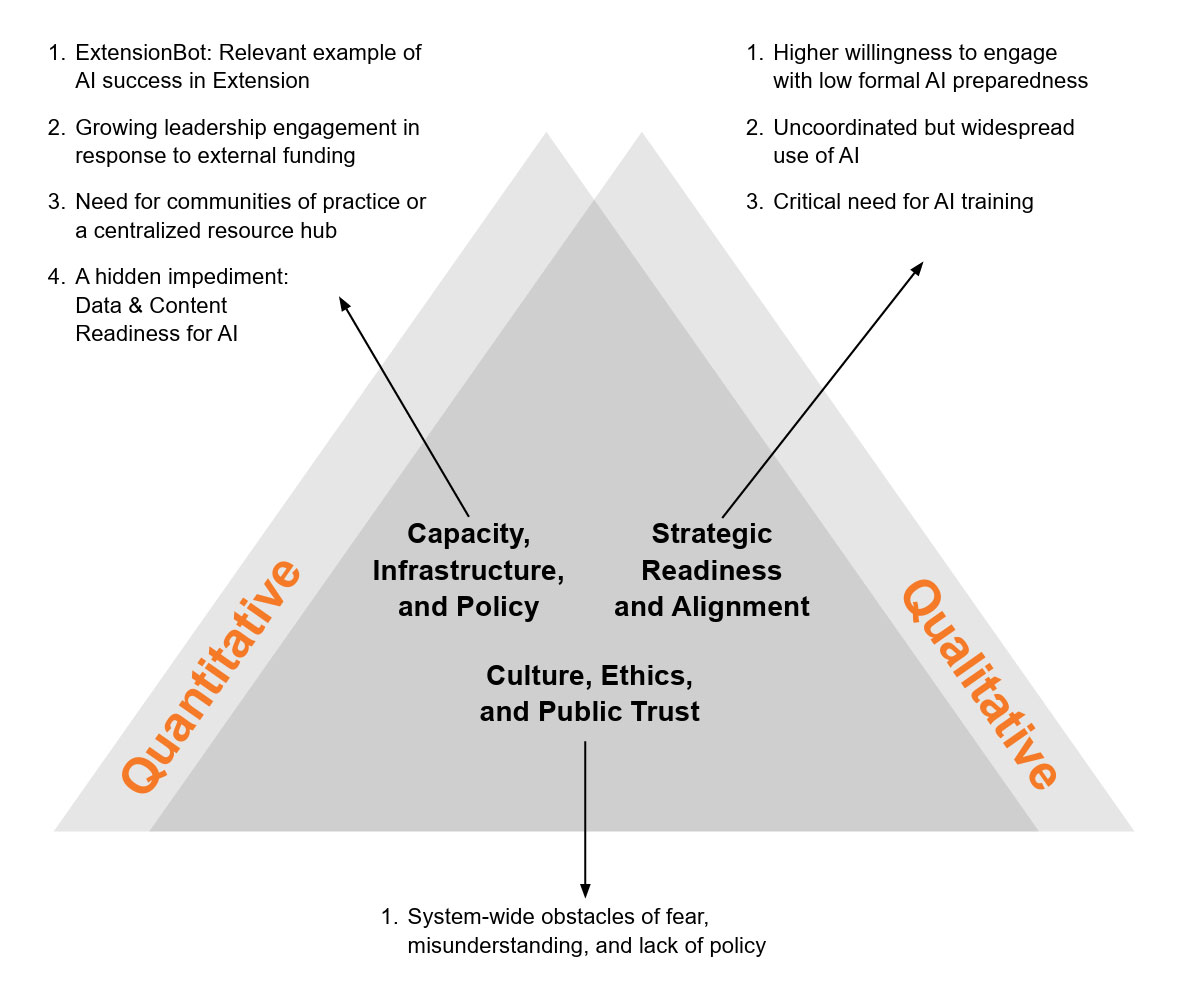
Following the dissemination of the quantitative survey, a qualitative focus group investigation was conducted during the first AI convening virtual meeting with Extension and agInnovation leaders and administrators. One hundred and six individuals representing 41 universities were in attendance.
The following themes emerged from the focus groups.
Phase 3
Following the exploratory discussions of Phase 2, the study advanced into a structured prioritization process designed to convert qualitative insights into clear, actionable focus areas for the Land-grant system.
Phase 4
Thematic analysis of Phases 2–4 revealed three themes: Culture, Ethics, and Public Trust; Capacity, Infrastructure, and Policy; and Strategic Readiness and Alignment. However, because the elements of Strategic Readiness and Alignment were already fully contained within the other two, we consolidated it moving forward and present the findings under the two overarching themes that most clearly reflect participants’ priorities. This consolidation does not remove this content, rather, it redistributes those elements under the two broader themes where they more logically belong. These themes synthesize hundreds of individual responses gathered through focus groups, prioritization activities, and implementation discussions, forming a comprehensive view of where Extension and agInnovation leaders believe coordinated action is most urgently needed.
Leaders across the Land-grant system consistently emphasized that AI adoption must remain human-centric, grounded in ethical principles, transparent practice, and public accountability. Participants warned that technical progress without safeguards could erode both credibility and community confidence.
Subtheme 1. Ethics and Human-Centrism The most widely discussed imperative was to ensure that AI strengthens rather than replaces human expertise. Participants proposed the development of a formal “human-centric” code of conduct led jointly by Extension and agInnovation Directors and Deans. This policy framework would codify expectations for human oversight in all AI-supported research, teaching, and outreach activities. Such a framework would serve as a reference point for how AI tools are used, evaluated, and communicated, ensuring that institutional values and community trust remain central to technological innovation.
Subtheme 2. Attribution and Transparency Leaders identified a strong need for consistent, verifiable attribution of AI contributions in publications and outputs. Respondents recommended standardized attribution guidelines that clearly distinguish where and how AI was used, differentiating between research papers and Extension materials. They also urged expansion of open-access publishing so AI systems can train on transparent, peer-reviewed data. This aligns with federal open-access mandates and reinforces integrity by making AI-assisted work traceable and auditable.
Subtheme 3. Risk Prevention Participants cautioned that unchecked AI adoption could inadvertently displace critical thinking and essential human skills. To prevent this, institutions should frame AI explicitly as a tool that augments human capacity. Continuous professional development and reflective training were identified as the best safeguards against dependence on automated outputs.
Subtheme 4. Public Trust Trust was recognized as the ultimate determinant of success. Leaders called for systematic efforts to measure stakeholder trust and to design AI applications that respect the comfort levels and expectations of end users. Transparent communication, demonstrated accountability, and community involvement in AI design were cited as key to sustaining public confidence in both Research and Extension programs.
The second theme addresses the structural conditions necessary to scale AI responsibly: a capable workforce, collaborative frameworks, and coordinated policy governance. Participants repeatedly emphasized that without shared infrastructure and systematic training, adoption would remain fragmented and unsustainable.
Subtheme 1. AI Workforce Readiness
Training emerged as the single most dominant priority. Leaders proposed a national, tiered AI training program led by Extension, featuring beginner-to-advanced pathways for faculty, researchers, agents, and community audiences.
Key components include:
Participants stressed that training must demonstrate tangible efficiency gains and be embedded within institutional strategic plans to reach beyond early adopters.
Subtheme 2. Collaborative Framework
No single university can meet AI demands alone. Leaders urged the creation of system-wide alliances across the Extension Committee on Organization and Policy, and other partners to coordinate resources and prevent duplication. Examples included joint funding proposals, shared centers of excellence, and cross-state learning communities. The Extension Foundation was identified as a potential platform for distributing resources, webinars, and best-practice repositories that benefit all Land-grant types (1862, 1890, and 1994). Summary
Subtheme 3. Policies and Best Practices
Governance must evolve in parallel with technology. Participants called for institution-wide policies clarifying acceptable AI use in research, teaching, and Extension outputs.
Recommendations included:
Subtheme 4. Infrastructure, Resource Allocation, and Funding
Sustainable AI integration depends on access to physical and financial resources. Leaders underscored the need for shared data repositories, compute capacity, and broadband access, as well as new funding mechanisms to offset training and infrastructure costs. They highlighted public-private partnerships and coordinated grant strategies as essential for building durable AI infrastructure across all institutions, including those with limited internal capacity.
Across both themes, participants voiced a consistent conclusion: policy must lead technology. Human oversight, ethical governance, and coordinated capacity building are prerequisites for AI to achieve its full potential in research and community engagement. AI should not be treated as an isolated innovation but as a system-wide transformation requiring collaboration, investment, and trust.
Phase 5
This phase expands the study beyond leadership perspectives to incorporate the lived experience of Extension professionals across roles and program areas. Conducted during the Joint Council of Extension Professionals (JCEP) national conference, this phase captures how AI adoption is being experienced in practice, including operational realities, capacity constraints, and emerging ethical considerations. The findings below represent a system-level synthesis of these perspectives, highlighting both reinforcing patterns and critical tensions across the Land-grant system.
The most pervasive finding across all data is a state of institutional suspension characterized by fragmented information and an absence of clear departmental structure. Extension professionals report navigating a landscape of vague guidance and conflicting organizational silos, where legal and technical requirements remain largely difficult to access to those on the ground.
This governance vacuum creates significant professional anxiety, as staff are cautioned about the risks of technology without being provided the necessary roadmaps or structural support to manage those risks safely. There is a resounding demand for a transition from individual, ad hoc experimentation to a coordinated, top-down organizational commitment.
This includes the development of formal policies, clearly defined parameters for safe use, and a national pooling of resources to address the current state of policy fragmentation.
The integration of AI has triggered an existential tension regarding the value of the Extension professional as an expert. There is a growing divide between the superficial efficiency offered by automated tools and the deep cognitive labor required to maintain scholarly integrity.
Faculty express concern that an institutional emphasis on efficiency and output may shift their role from original knowledge creation to that of an information verifier. In this emerging paradigm, educators report spending increasing amounts of time auditing and fact-checking AI-generated content, a shift that risks devaluing the unique thought processes and research-based expertise that define Land-grant academics.
To protect the integrity of the system, there is a strong call for institutional guardrails that preserve the visibility of human and science-based origins of knowledge, ensuring that critical thinking and scholarly contribution remain central.
At the core of the Extension mission is a human-to-human feedback loop that professionals fear is being disrupted by algorithmic mediation. This theme emphasizes the educator’s role as a curator and guardian of public trust, responsible for protecting communities from non-vetted, biased, or incorrect information.
This responsibility is especially pronounced in youth programming, including 4-H, where concerns center on the potential for technology to replace human relationships or compromise privacy. Extension professionals increasingly view themselves as a frontline defense, helping the public identify misinformation, recognize red flags, and navigate digital content responsibly.
Trust is not perceived as an inherent feature of AI systems, but rather as a function of the educator’s transparency, academic rigor, and accountability. This reinforces the need for university-verified, research-based resources to ensure Extension remains a trusted source of evidence.
A significant barrier to organizational readiness is a severe limitation in professional capacity, combined with a lack of clarity around what constitutes AI proficiency. Many professionals perceive AI adoption as an additional responsibility layered onto an already full workload, without corresponding adjustments in time, expectations, or support.
This capacity strain is compounded by technical barriers, including the cost of tools and cybersecurity restrictions that limit access and experimentation. Additionally, because AI readiness is a moving and often undefined target, many in the workforce feel they are falling behind.
To address this, there is a strong call for a transition from passive awareness to structured, mandatory professional development. This includes clearly defined competencies, dedicated time for training within the workweek, and institutional support that aligns expectations with available capacity.
A unique and critical dimension of the findings is the ethical tension between AI adoption and the Extension mission of resource stewardship. Many professionals identify a contradiction between promoting sustainability and adopting technologies that require significant energy and water consumption through large-scale data infrastructure.
This environmental impact is not viewed as a secondary concern, but as a central moral conflict. Extension professionals express concern that adoption, if driven primarily by external or corporate pressures, may conflict with the values and responsibilities they are tasked with upholding.
This creates a perception of systemic inconsistency, where educators may feel compelled to adopt technologies that could negatively impact the very communities they serve. Addressing this tension will require greater transparency, consideration of environmental impact in tool selection, and a commitment to intentional, minimal, and purpose-driven use of AI.
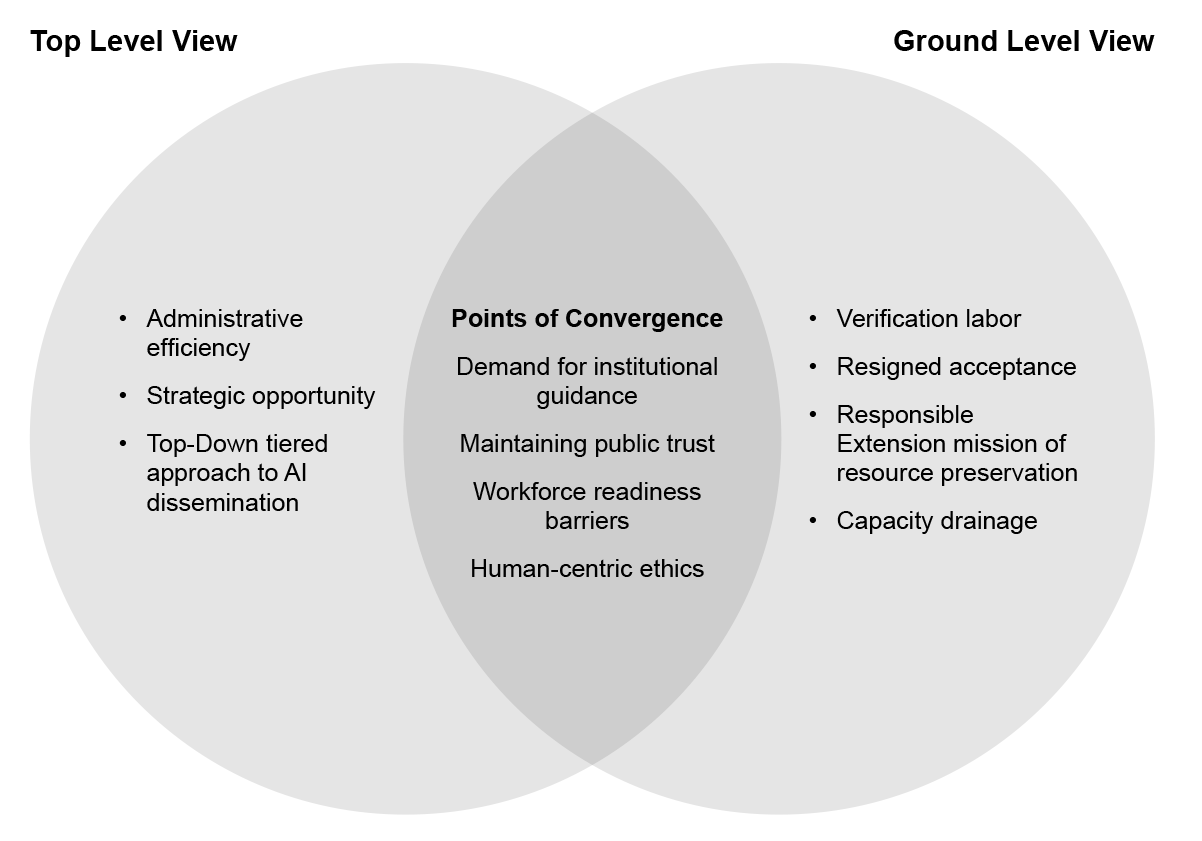
The comparison between leadership-level findings and workforce-level experiences reveals a system that is broadly aligned on long-term goals, but divided in how AI adoption is currently being experienced in practice. While leadership perspectives emphasize strategy, infrastructure, and future potential, Extension professionals describe a present-state experience characterized by uncertainty, constraint, and ethical tension.
Points of Convergence
The areas of alignment indicate a shared understanding of the foundational requirements for a successful AI transition:
Points of Divergence
The differences between leadership and workforce perspectives reveal a policy–implementation gap, where strategic vision has not yet translated into operational clarity:
Visual Thematics of the Points of Convergence and Divergence
Top and Ground Level AI Preparedness and Policy Data of the AI Convening (2025-2026)
The AI Convening demonstrated that both Cooperative Extension and agInnovation leaders recognize AI as a defining factor in the future of research, education, and outreach across the Land-grant system. Participants viewed AI not as a single tool, but as an ecosystem-level transformation affecting how information is created, validated, shared, and applied. The discussions revealed broad enthusiasm and optimism about AI’s potential, while subsequent workforce-level findings reveal a more complex operational reality defined by uncertainty, capacity strain, and ethical tension. The system’s success will depend on coordinated readiness, ethical governance, and investment in people and infrastructure. The convening sessions offered a clear message: both Extension and agInnovation are poised to take further steps in shaping responsible, mission-driven uses of AI, but doing so will require shared standards, structured collaboration, and a national vision that bridges leadership strategy with on-the-ground implementation.
AI experimentation is already occurring across the Land-grant system. Faculty, researchers, and educators are independently piloting AI tools for literature synthesis, data analysis, stakeholder communication, and decision support. This decentralized experimentation has generated valuable insights, yet leaders acknowledged that progress remains uneven and largely uncoordinated. Workforce findings further indicate that this experimentation is often occurring without sufficient guidance, creating variability in practice and uncertainty around acceptable use.
Participants agreed that the next phase must focus on structured implementation. Both Extension and agInnovation institutions need frameworks that align experimentation with organizational priorities, create consistency across outputs, and promote cross-state learning and sharing. The challenge ahead is to connect local innovation with national coordination, enabling knowledge to scale without losing institutional flexibility while reducing the current state of fragmentation and policy ambiguity.
A strong consensus emerged that workforce readiness is the most significant barrier to AI adoption. Both Extension and agInnovation rely on a workforce that blends subject-matter expertise with community engagement and applied research. Yet most professionals have not received structured training in AI literacy, ethics, or application. Workforce perspectives further reveal that AI is frequently perceived not as an opportunity, but as an additional burden layered onto already constrained workloads.
Participants emphasized that a tiered approach to workforce development is needed. Basic digital literacy must be coupled with advanced technical and ethical competencies for specialists, researchers, and educators. This training should not only focus on how to use AI tools, but also on how to critically evaluate AI-generated information, validate data, and communicate transparently with stakeholders. Importantly, readiness cannot be achieved without dedicated time, institutional support, and alignment between expectations and capacity. Without these conditions, training efforts risk limited adoption and uneven impact.
Both Extension and agInnovation leaders reaffirmed that people must remain at the center of AI integration. Participants were clear that technology should augment human expertise, not replace it. This human-centric approach preserves the credibility, trust, and relational foundation that have defined the Land-grant mission for more than a century.
Leaders identified a strong need for shared ethical frameworks, including policies on attribution, data privacy, intellectual property, and algorithmic fairness. A framework developed collaboratively across the system could help ensure that AI tools are used transparently and in alignment with Land-grant values. Workforce findings reinforce this need, highlighting concerns around “intellectual sovereignty,” where professionals fear a shift from knowledge creation to verification of AI-generated content. Addressing this requires governance structures that preserve the visibility of human expertise, authorship, and scientific rigor.
Additionally, trust emerged as a central theme across both datasets. Trust is not viewed as an inherent feature of AI systems, but as a function of the transparency, accountability, and academic integrity of Extension professionals. Ensuring that AI-enabled outputs remain grounded in university-verified, research-based content will be essential to maintaining Extension’s role as a trusted public resource.
Infrastructure disparities emerged as a major concern. While some institutions have advanced data systems and internal AI policies, others are still developing the foundational digital and policy environments necessary for integration. Participants noted that AI readiness requires not only technical infrastructure such as broadband, storage, and computing capacity, but also structured, available, and validated data.
Shared data repositories, consistent metadata standards, and aligned policies on availability and governance were identified as key enablers for cross-institutional collaboration. Additionally, with concerns around data privacy and data security, institutions may consider training or educational best practices for those building and using AI applications. These investments would allow Extension and agInnovation to more effectively connect research outputs with educational and applied use cases, creating a unified ecosystem of reliable, AI-ready information.
Workforce findings further emphasize that gaps in policy clarity and access to approved tools contribute to a broader sense of institutional ambiguity, where professionals are expected to manage risk without clear guidance. Addressing these gaps will be essential for enabling consistent and confident adoption across the system.
The findings from the convening underscore that AI readiness represents both a challenge and an opportunity for Cooperative Extension and agInnovation. The decentralized nature of the Land-grant system remains a double-edged sword: it encourages innovation and adaptation, but can also lead to fragmentation if not intentionally aligned. The addition of workforce perspectives makes clear that this fragmentation is already being felt at the operational level, where professionals are navigating unclear expectations and uneven support structures.
To sustain national leadership in research and community engagement, Extension and agInnovation must advance in tandem. AI has the potential to accelerate the translation of research into practice, improve decisionmaking, and expand access to knowledge for all communities. Achieving this potential will depend on shared investment in training, infrastructure, policy development, and data stewardship.
At the same time, the system must reconcile emerging ethical tensions, including the environmental impact of AI technologies and their alignment with Extension’s mission of sustainability and resource stewardship. Addressing this dimension will require intentional decision-making around tool selection, usage, and long-term impact.
Ultimately, the path forward is not defined by adoption alone, but by intentional, values-aligned integration. The Land-grant system is uniquely positioned to lead in this space, not only by implementing AI, but by shaping how it is applied in the service of public good, scientific integrity, and community trust.
The AI Convening emphasized that Extension and agInnovation leaders should translate ideas into actionable strategies for building AI readiness across the Land-grant system. The recommendations below represent the most prominent themes identified through the prioritization and implementation sessions. They reflect a shared vision among participants for creating a coordinated, ethical, and sustainable approach to Artificial Intelligence in research, education, and outreach. Findings from workforce-level engagement further reinforce that this vision must be operationalized in ways that are easy to access, supported, and realistic for professionals across all roles. This also means to observe, acknowledge, and address the perceptions and fears of workforce.
Key Recommendations:
Key Recommendations:
Key Recommendations:
Key Recommendations:
The findings from this study highlight both the momentum and the complexity of advancing AI across Cooperative Extension and agInnovation. While enthusiasm is strong, meaningful progress will depend not only on national coordination and leadership, but on how institutions interpret and operationalize these priorities within their own contexts.
Workforce findings further emphasize that successful adoption will require alignment between strategy and the day-to-day realities of Extension professionals. As institutions move forward, the following questions can be used to further guide local explorations, decision-making, and plans for implementation.
Institutional Governance and Strategy
Workforce Readiness and Capacity
Infrastructure, Data, and Access
Ethics, Trust, and the Extension Mission
Collaboration and System Alignment
Advancing AI across the Land-grant system will require more than adoption, it will require intentional, values-aligned integration at every level. While national coordination efforts, such as the AI Program Action Team, will provide structure and direction, the success of this work ultimately depends on how institutions and professionals engage with these questions locally.
As the Land-grant system advances toward a coordinated national strategy for Artificial Intelligence, the Extension Foundation continues to play a facilitative role in supporting Cooperative Extension and agInnovation with tools, infrastructure, and expertise that help translate system priorities into implementation. Findings from both leadership and workforce engagement reinforce that this translation, from strategy to practice, is the critical gap the system must now address. The insights and priorities emerging from this study align closely with several active NIFA-funded initiatives currently stewarded by the Foundation, particularly those advancing data readiness, workforce training, and AI-informed content infrastructure.
Through the New Technologies for Ag Extension (NTAE) program, the Extension Foundation has developed a portfolio of scalable, interoperable technologies designed to strengthen institutional capacity for AI adoption. Central to this work is MERLIN (Machine-driven Extension Research and Learning Innovation Network), a structured data platform that organizes, validates, and standardizes research and educational content for Extension and agInnovation.
MERLIN enables Land-grant universities to prepare their data ecosystems for AI-driven applications by creating structured, shareable, and regularly updated datasets. This ensures that research outputs, fact sheets, and publications remain available, verifiable, and ready for integration with current and emerging AI systems.
This approach directly addresses workforce-identified challenges related to fragmented data, inconsistent access to approved resources, and uncertainty around trusted content sources. By standardizing and validating information at scale, MERLIN reduces ambiguity and supports more consistent, confident use of AI across roles and institutions.
These efforts directly align with the priorities identified by convening participants, including shared infrastructure, increased availability, and consistent governance for data and content.
Complementing MERLIN is ExtensionBot, the Foundation’s national AI platform that makes validated Extension content discoverable and interactive. ExtensionBot allows institutional partners to customize chat-based interfaces powered by their own data sourced from MERLIN, enabling trusted, real-time responses to stakeholder inquiries.
This approach supports the convening’s calls for workforce development and strategic alignment by providing a tangible, ethical framework for AI adoption. It also directly responds to workforce concerns around verification burden and public trust by ensuring that AI-generated responses are grounded in curated, research-based content rather than unverified external sources.
Through these systems, institutions can explore AI use cases, strengthen internal capacity, and demonstrate transparent AI engagement with the public, while ensuring that all outputs remain grounded in peer-reviewed, research-based information.
To further support the national direction recommended in the convening, the Foundation is positioned to collaborate with ECOP, the proposed AI Program Action Team, and networks such as NDEET. These collaborations can help organize, coordinate, and nationalize training offerings that draw on the expertise of Land-grant content specialists, ensuring broad, consistent access to high-quality professional development across the system. Importantly, these efforts can help move the system from passive awareness to structured, competency-based training that aligns with real workforce capacity and expectations.
A central outcome of the AI Convening was the systemwide agreement that AI must remain human-centered: a tool to amplify, not replace, the expertise of researchers, educators, and Extension professionals. The Foundation’s tools embody this principle.
ExtensionBot requires human validation and content review before public release, while MERLIN’s structure promotes transparency in authorship, attribution, and version control. These features ensure that AI integration enhances, rather than compromises, the trust and credibility that define the Land-grant mission.
This model also directly addresses workforce concerns related to intellectual sovereignty and the preservation of expert identity, ensuring that human knowledge creation, interpretation, and accountability remain central in AI-assisted environments.
As the system continues to evolve, the Foundation is positioned not only to provide tools, but to help shape a national model for responsible, transparent, and mission-aligned AI implementation that balances innovation with public trust, and efficiency with scientific integrity.
From Consensus to Coordinated Action
Artificial intelligence is a defining shift in our world. This study confirms that the Land-grant system is ready to lead the way in navigating this new technology across its research, education, and community engagement missions, but doing so will require bridging the gap between leadership vision and workforce reality. If we align our policies, training, and data infrastructure around a shared national strategy, and ensure those strategies are operationalized across all roles and institutions, the system is positioned to lead.
Through a national survey and a series of leadership convenings, this work has moved the system beyond scattered, isolated experiments. With the addition of workforce perspectives, it also reveals the operational challenges, capacity constraints, and ethical tensions that must be addressed to move forward effectively. We now have a unified vision for moving forward.
The consensus from leaders across Cooperative Extension and agInnovation, representing 1862, 1890, and 1994 institutions, is more than just an observation. It is a clear mandate for action, built on three core priorities:
This study marks a turning point from individual exploration to an intentional, coordinated strategy. The challenge leaders identified is not technical, it’s organizational: how to harness local innovation within a single, national framework.
The next phase of this work will require sustained leadership, shared accountability, and continued alignment between strategy and implementation.
The essential first step is to create the National AI Program Action Team (PAT). With support from partners like the Extension Foundation, this team will put the plan into action. This group, led by ECOP and agInnovation, can provide the leadership needed to align training, develop policy, and coordinate infrastructure investment. It will also play a critical role in ensuring that national strategies translate into practical, usable frameworks that support professionals across the system.



Stay up to date with the Extension Foundation.